
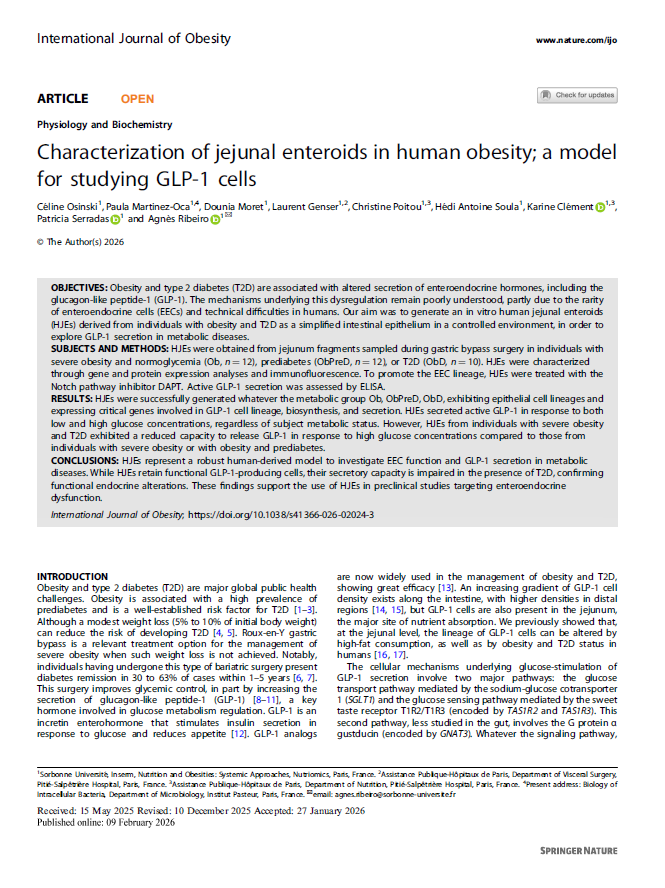
On February 9, 2026, the JEMINI project published an article titled “Characterization of jejunal enteroids in human obesity; a model for studying GLP-1 cells” in the International Journal of Obesity.
This work aligns with the project’s objectives, which aim to better understand the role of the proximal intestine—particularly the jejunum—in metabolic regulation, and to identify new therapeutic targets based on interactions between the microbiota, intestinal epithelium, and endocrine functions.
Obesity, like type 2 diabetes, is associated with impaired secretion of enteroendocrine hormones, notably GLP-1 (glucagon-like peptide-1), whose production is partly localized in the proximal intestine. Due to the scarcity of enteroendocrine cells, the authors developed human jejunal enteroids derived from patients with obesity and with or without type 2 diabetes to explore the mechanisms of hormonal secretion in vitro.
The results show that enteroids derived from patients with type 2 diabetes exhibit impaired GLP-1 secretion, highlighting early dysfunction in the jejunal epithelium. This study demonstrates the robustness of human jejunal enteroids as an experimental model for studying the endocrine functions of the proximal intestine.
This research reinforces the importance of the upper intestine as a key site of metabolic regulation and illustrates the potential of the approaches developed in JEMINI to better understand the mechanisms of metabolic diseases and identify new targeted therapeutic strategies.
- Céline Osinski, Sorbonne Université – Inserm
- Paula Martinez-Oca, Sorbonne Université – Inserm
- Dounia Moret, Sorbonne Université – Inserm
- Laurent Genser, Sorbonne Université – Inserm, AP-HP
- Christine Poitou, Sorbonne Université – Inserm, AP-HP
- Hédi Antoine Soula, Sorbonne Université – Inserm
- Karine Clément, Sorbonne Université – Inserm, AP-HP
- Patricia Serradas, Sorbonne Université – Inserm
- Agnès Ribeiro, Sorbonne Université – Inserm