
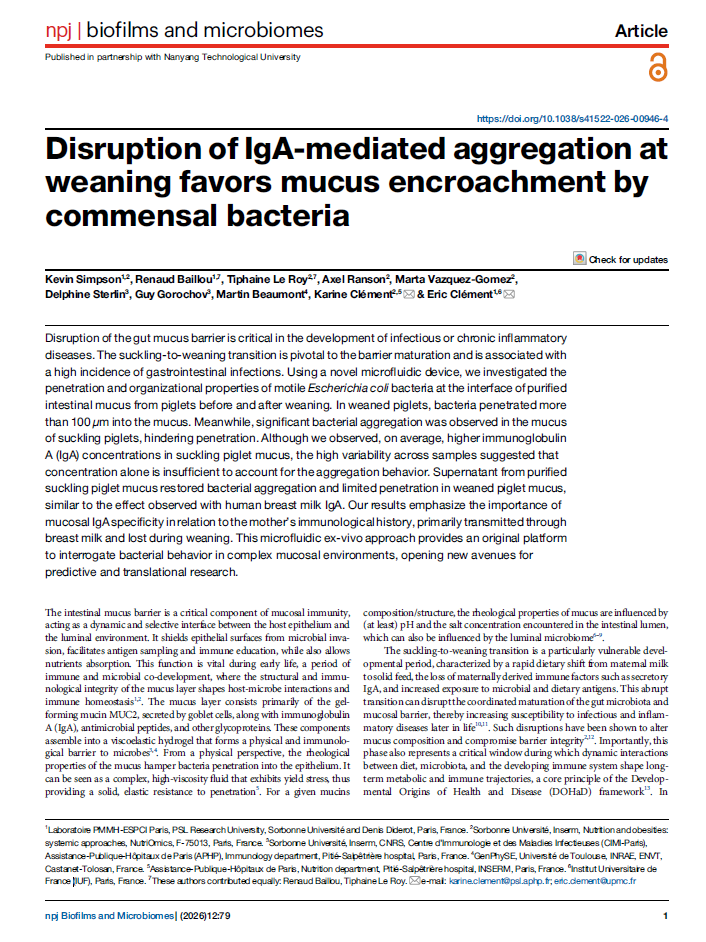
On March 3, 2026, the JEMINI project published an article titled “Disruption of IgA-mediated aggregation at weaning favors mucus encroachment by commensal bacteria” in npj Biofilms and Microbiomes.
Disruption of the intestinal mucosa plays a key role in the development of chronic infectious or inflammatory diseases. The transition period between breastfeeding and weaning is crucial for the maturation of this barrier: it is accompanied by major changes in immunity and the gut microbiota, as well as a high incidence of gastrointestinal infections.
The authors developed an innovative microfluidic device to study the penetration and organizational properties of motile Escherichia coli bacteria at the interface of the intestinal mucosa before and after weaning.
The study shows that the loss of maternal immunoglobulin A (IgA) during weaning reduces the ability of intestinal mucus to aggregate bacteria, allowing them to penetrate deeper into the mucosal barrier. This phenomenon could play a key role in immune maturation and early metabolic trajectories.
Among other goals, JEMINI aims to understand the mechanisms of host-microbiome interactions in healthy and diseased populations. Their findings thus open new avenues for better studying
– critical windows of early development
– microbiota–immunity interactions
– early determinants of metabolic and inflammatory diseases
– the impact of the nutritional environment
- Kevin Simpson, Sorbonne Université, ESPCI, PSL Research University, Paris Cité – Inserm
- Renaud Baillou, Sorbonne Université, ESPCI, PSL Research University
- Tiphaine Le Roy, Sorbonne Université – Inserm
- Axel Ranson, Sorbonne Université – Inserm
- Marta Vazquez-Gomez, Sorbonne Université – Inserm
- Delphine Sterlin, Sorbonne Université – Inserm, AP-HP
- Guy Gorochov, Sorbonne Université – Inserm, AP-HP
- Martin Beaumont, Université de Toulouse – INRAE
- Karine Clément, Sorbonne Université – Inserm, AP-HP
- Éric Clément, ESPCI PSL Research University, Sorbonne Université, Paris Cité – Institut Universitaire de France