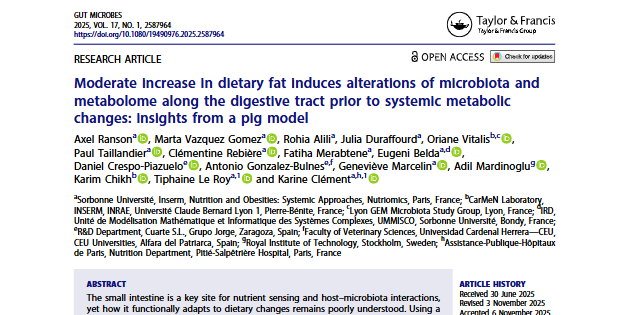
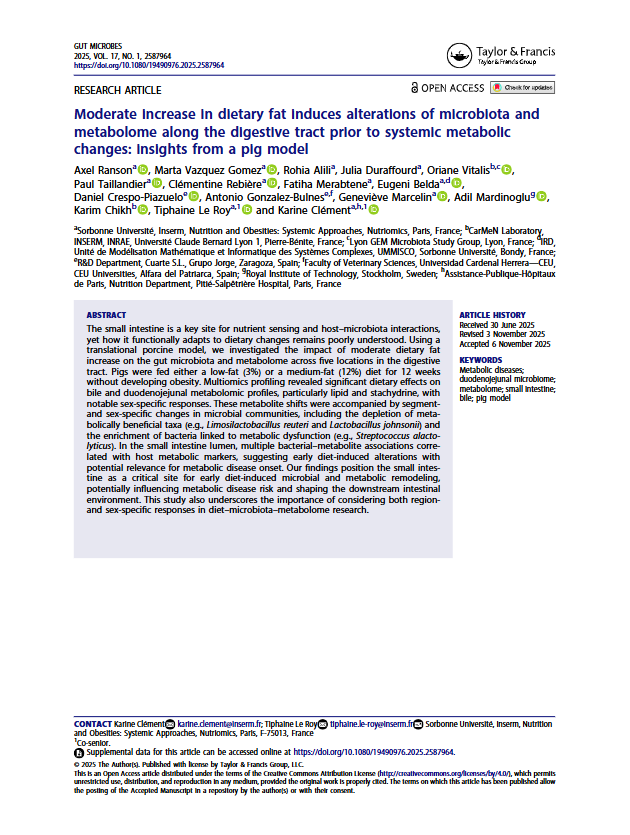
On December 1, 2025, the JEMINI project published an article titled “Moderate increase in dietary fat induces alterations of microbiota and metabolome along the digestive tract prior to systemic metabolic changes: insights from a pig model” in Gut Microbes.
JEMINI aims to deepen our understanding of the duodenal-jejunal microbiota, an ecosystem that remains largely unexplored despite being located at the heart of the small intestine, a key organ in regulating the host’s metabolism and immunity.
While this compartment is a major site of host–microbiota interactions, the mechanisms of adaptation to dietary changes remain poorly characterized. In this study, the authors analyzed the impact of a moderate increase in lipid intake on the microbiota and metabolome at different levels of the porcine digestive tract.
The results highlight early changes in metabolomic profiles, particularly in bile and the duodenum-jejunum, as well as specific associations between bacteria and metabolites that correlate with host metabolic markers. These data suggest that diet-induced alterations occur early in the proximal intestine and may contribute to the development of metabolic diseases.
The small intestine thus appears to be a critical site for diet-induced microbial and metabolic remodeling, capable of exerting a lasting influence on metabolic risk.
- Axel Ranson, Sorbonne Université – Inserm
- Marta Vazquez Gomez, Sorbonne Université – Inserm
- Rohia Alili, Sorbonne Université – Inserm
- Julia Duraffourd, Sorbonne Université – Inserm
- Oriane Vitalis, Inserm, INRAE, Université Claude Bernard Lyon 1
- Paul Taillandier, Sorbonne Université – Inserm
- Clémentine Rebière, Sorbonne Université – Inserm
- Fatiha Merabtene, Sorbonne Université – Inserm
- Eugeni Belda, Sorbonne Université – Inserm
- Daniel Crespo-Piazuelo, Cuarte S.L.
- Antonio Gonzalez-Bulnes, Universidad Cardenal Herrera
- Geneviève Marcelin, Sorbonne Université – Inserm
- Adil Mardinoglu, Royal Institute of Technology
- Karim Chikh, Inserm, INRAE, Université Claude Bernard Lyon 1
- Tiphaine Le Roy, Sorbonne Université – Inserm
- Karine Clément, Sorbonne Université – Inserm, AP-HP