
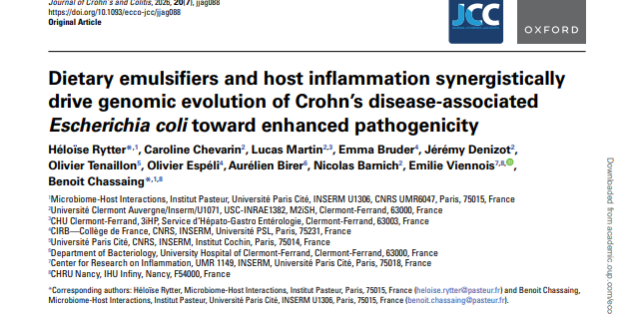
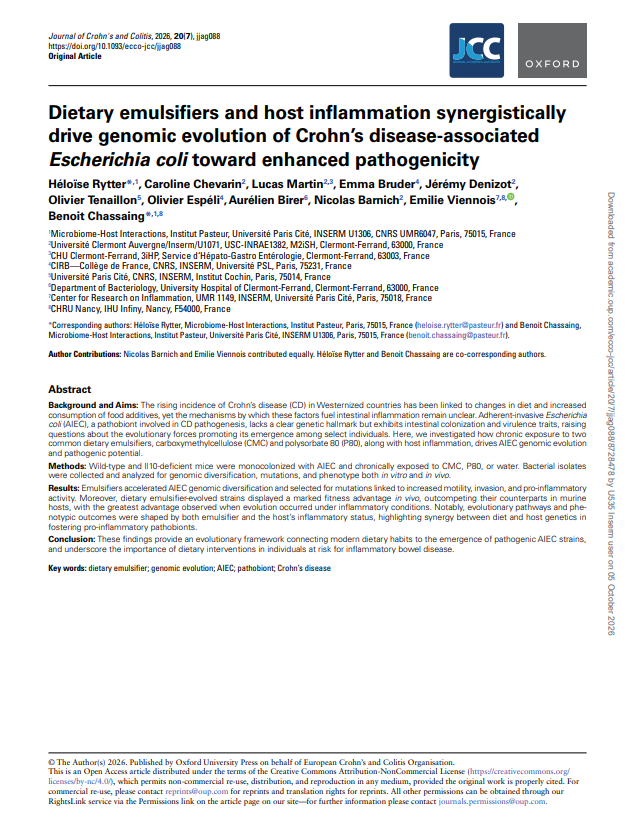
On July 8, 2026, the AddiMapping project published an article titled “Dietary emulsifiers and host inflammation synergistically drive genomic evolution of Crohn’s disease-associated Escherichia coli toward enhanced pathogenicity” in the Journal of Crohn’s and Colitis.
The Western diet, characterized by exposure to numerous food additives, is associated with an increased incidence of Crohn’s disease (CD). However, the mechanisms by which these compounds trigger or sustain intestinal inflammation remain poorly understood.
Adherent-invasive Escherichia coli (AIEC) is a pro-inflammatory bacterium associated with CD. In their study, the authors analyzed the impact of chronic exposure to two food emulsifiers (carboxymethylcellulose and polysorbate 80) on the inflammatory potential of AIEC.
It has been shown that chronic exposure to these emulsifiers:
– Accelerates the genomic evolution of AIEC
– Promotes the selection of mutations associated with increased bacterial motility, invasiveness, and pro-inflammatory activity in AIEC
– Provides AIEC bacteria with an adaptive advantage, which is more pronounced when evolution occurs under inflammatory conditions
This research thus highlights a synergy between diet and host genetics that promotes the proliferation of pro-inflammatory bacteria, and establishes a link between modern dietary habits and the emergence of more virulent AIEC strains.
Nutritional interventions in individuals at risk for IBD therefore appear to be a key preventive strategy.
- Héloïse Rytter, Institut Pasteur, Université Paris Cité – Inserm, CRNS
- Caroline Chevarin, Université Clermont Auvergne – Inserm, INRAE
- Lucas Martin, Université Clermont Auvergne – Inserm, INRAE – CHU Clermont-Ferrand
- Emma Bruder, Collège de France – CNRS, Inserm, Université PSL
- Jérémy Denizot, Université Clermont Auvergne – Inserm, INRAE
- Olivier Tenaillon, Université Paris Cité, CNRS, Inserm, Institut Cochin
- Olivier Espéli, Collège de France – CNRS, Inserm, Université PSL
- Aurélien Birer, CHU Clermont-Ferrand
- Nicolas Barnich, Université Clermont Auvergne – Inserm, INRAE
- Emilie Viennois, Center for Research on Inflammation – Inserm, Université Paris Cité – CHRU Nancy
- Benoit Chassaing, Institut Pasteur, Université Paris Cité – Inserm, CRNS – CHRU Nancy