
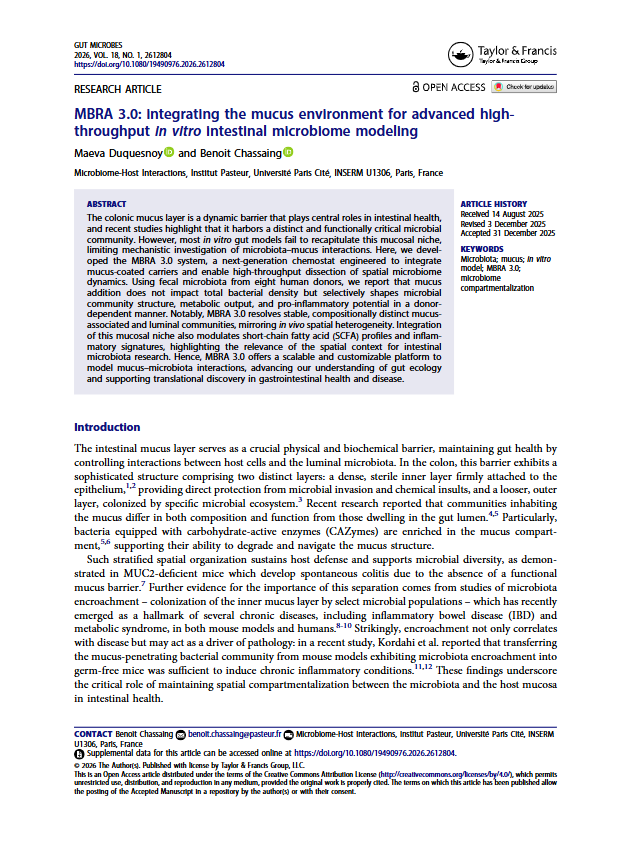
On January 11, 2026, the AddiMapping project published an article titled “MBRA 3.0: integrating the mucus environment for advanced high-throughput in vitro intestinal microbiome modeling” in Gut Microbes.
The mucosal layer of the colon plays a central role in gut health and harbors a distinct microbial community of crucial functional importance. Unfortunately, most in vitro intestinal models fail to replicate this mucosal niche.
In this study, the authors developed the MBRA 3.0 system, a next-generation chemostat designed to incorporate mucus-coated substrates and enable high-throughput analysis of the spatial dynamics of the microbiome.
Using human fecal microbiota, the study demonstrates that the addition of mucus has no impact on total bacterial density but selectively alters the structure of the microbial community, metabolic output, and pro-inflammatory potential in a donor-dependent manner. It also modulates short-chain fatty acid (SCFA) profiles and inflammatory signatures.
MBRA 3.0 thus offers a scalable and customizable platform for modeling the interactions between mucus and the microbiota.
- Maeva Duquesnoy, Institut Pasteur – Université Paris Cité / Inserm
- Benoit Chassaing, Institut Pasteur – Université Paris Cité / Inserm