
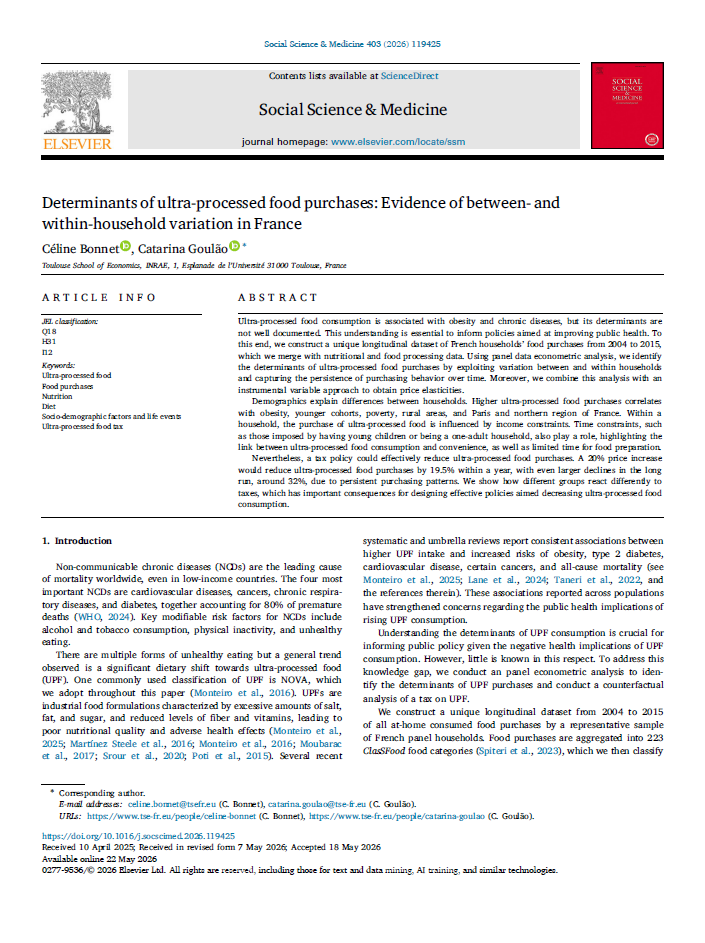
On May 18, 2026, an article titled “Determinants of ultra-processed food purchases: evidence of between- and within-household variation in France” was published in Social Science and Medicine as part of the DynAPol-3P project.
Ultra-processed foods (UPF) are becoming an increasingly prominent part of modern diets. Their consumption is now associated with an increased risk of obesity, type 2 diabetes, cardiovascular disease, certain cancers, and premature mortality.
In their article, the authors examined the determinants of ultra-processed food purchases in France. Drawing on a representative panel of French households tracked between 2004 and 2015, the authors analyze the economic, demographic, and social factors associated with UPF consumption. The originality of their study lies in its ability to distinguish between persistent differences among households and behavioral changes linked to life events such as the arrival of a child, a change in income, or changes in household composition.
The results show that purchases of UPF are higher among younger generations, low-income households, people who are obese, and residents of certain geographic areas. The study also highlights the role of time constraints: households with young children and single-parent families rely more heavily on ultra-processed foods, likely because they are convenient and quick to prepare.
Beyond analyzing dietary behaviors, the authors assess the potential impact of a tax policy targeting UPF. According to their estimates, a 20% increase in the price of ultra-processed foods would lead to a decrease of approximately 19.5% in purchases as early as the first year. According to the estimates, such a measure would lead nearly 80% of the population to reduce their consumption by the equivalent of one ultra-processed pizza per week, and more than half to give up the equivalent of one ultra-processed croissant per day. The effects are more significant in the long term due to the persistence of consumption habits.
The results reveal a concerning generational trend: younger generations are consuming more UPF, which could lead to a sustained increase in consumption. They underscore the need for early intervention among young people by regulating marketing, improving the food environment, and developing healthy, convenient, and affordable alternatives. The role of income and time constraints also shows that policies cannot be limited to raising awareness. Finally, taxes on UPF appear to be an effective lever for bringing about lasting changes in dietary habits and improving public health.
This publication led to the policy brief “Determinants of Ultra-Processed Food Purchases in France: What Leverage Points for Public Policy?”, which presents the study’s key findings and discusses several courses of action to reduce UPF consumption.
- Céline Bonnet, Toulouse School of Economics – INRAE
- Catarina Goulão, Toulouse School of Economics – INRAE